Landing Page vs Full Website: Which One Does Your Business Actually Need?
Clients ask me this before we talk design, stack, or website cost: do we need a landing page or a full website? The wrong answer wastes ad spend or stalls website SEO for months. I build both for service businesses and startups, and the choice is rarely about taste. It is about traffic source, offer clarity, and how people buy from you.
12 min read · By Malik Taleeb Shahbaz · Updated 2026-09-06
Quick answer
Choose a landing page when one offer must convert paid or campaign traffic fast. Choose a full website when you need trust, multiple services, and compounding website SEO. Most businesses that keep growing eventually need both: a business website as the hub, and focused landers for lead generation campaigns.
Key takeaways
- Landing page vs website is a traffic and intent decision, not a design preference.
- A one page website is not automatically a high-converting landing page.
- Paid ads usually need dedicated landing page conversion pages, not your homepage.
- Full websites win on website SEO, brand trust, and multi-service discovery.
- Website cost and timeline favor a lander first only when the offer and channel are clear.
- The hybrid model (site + landers) is the normal end state for serious digital marketing.
Introduction
A founder once sent me a Figma file with fourteen pages, a blog plan, and a careers section. Their only traffic for the next two months was a Meta ads test for one coaching package. We paused the mega site, shipped one responsive website lander in a week, and finally had a clean conversion rate to judge.
That is the real landing page vs full website debate. People argue templates versus custom website builds. The sharper question is simpler: what job does this URL need to do in the next 90 days?
I write this as a developer who ships landing page development and multi-page business sites for clients across the US, UK, Gulf, and Pakistan. Below is the decision framework I use on scoping calls, including SEO, lead generation, website cost, and the hybrid setup most growing brands eventually need.
What is a landing page?
A landing page is a focused web page built around one primary action. Request a quote. Book a demo. Join a waitlist. Buy a package. Every section supports that action: headline, proof, offer detail, FAQ, and a repeated call to action.
Strong landers usually strip or minimize website navigation. Visitors arrived with a promise from an ad, email, or outreach message. Extra menus invite them to wander off and never convert.
Landing page vs one page website
People confuse a one page website with a landing page. A one-pager can still behave like a tiny brochure: soft goals, long story, multiple competing buttons. A true lander is stricter. One audience. One offer. One success metric.
- Landing page
- A conversion-focused page for a single campaign or offer, optimized for landing page conversion and message match with the traffic source.
- Call to action (CTA)
- The primary next step you want, such as submit a form, call, chat on WhatsApp, or start checkout.
- Message match
- Alignment between the ad or email promise and the page headline. Weak match kills paid conversion rate fast.
Pro tip: If you cannot write the primary CTA in six words, the page is not ready. Fix the offer before website design polish.
What is a full website?
A full website (or full business website) is a multi-page property. Typical structure: home, services or products, about, contact, maybe projects, pricing, and a blog. It supports strangers who are researching, comparing, and building trust over more than one visit.
This is the classic website for small business model. Different pages answer different questions. Service pages capture search intent. An about page humanizes the brand. A blog supports content-led business growth. Contact and booking paths close the loop.
Good website development here is not “more pages for vanity.” It is information architecture: clear paths, fast loads, responsive website layouts, and internal links that help both users and search engines.
If you are still deciding whether your current site is even “modern enough,” pair this article with my guide on why every business needs a modern website.
Key differences at a glance
Here is the practical website vs landing page comparison I share with clients before scoping.
| Factor | Landing page | Full website |
|---|---|---|
| Primary goal | One conversion action | Trust, discovery, multiple goals |
| Website navigation | Minimal or none | Full menu across pages |
| Best traffic | Ads, email, outreach, launches | Organic search, direct, referrals |
| Website SEO potential | Limited alone | Strong with structure and content |
| Typical conversion focus | High for matched campaigns | Moderate per page, broader funnel |
| Speed to launch | Days to a couple of weeks | Weeks to a few months |
| User experience style | Guided, linear | Exploratory, multi-path |
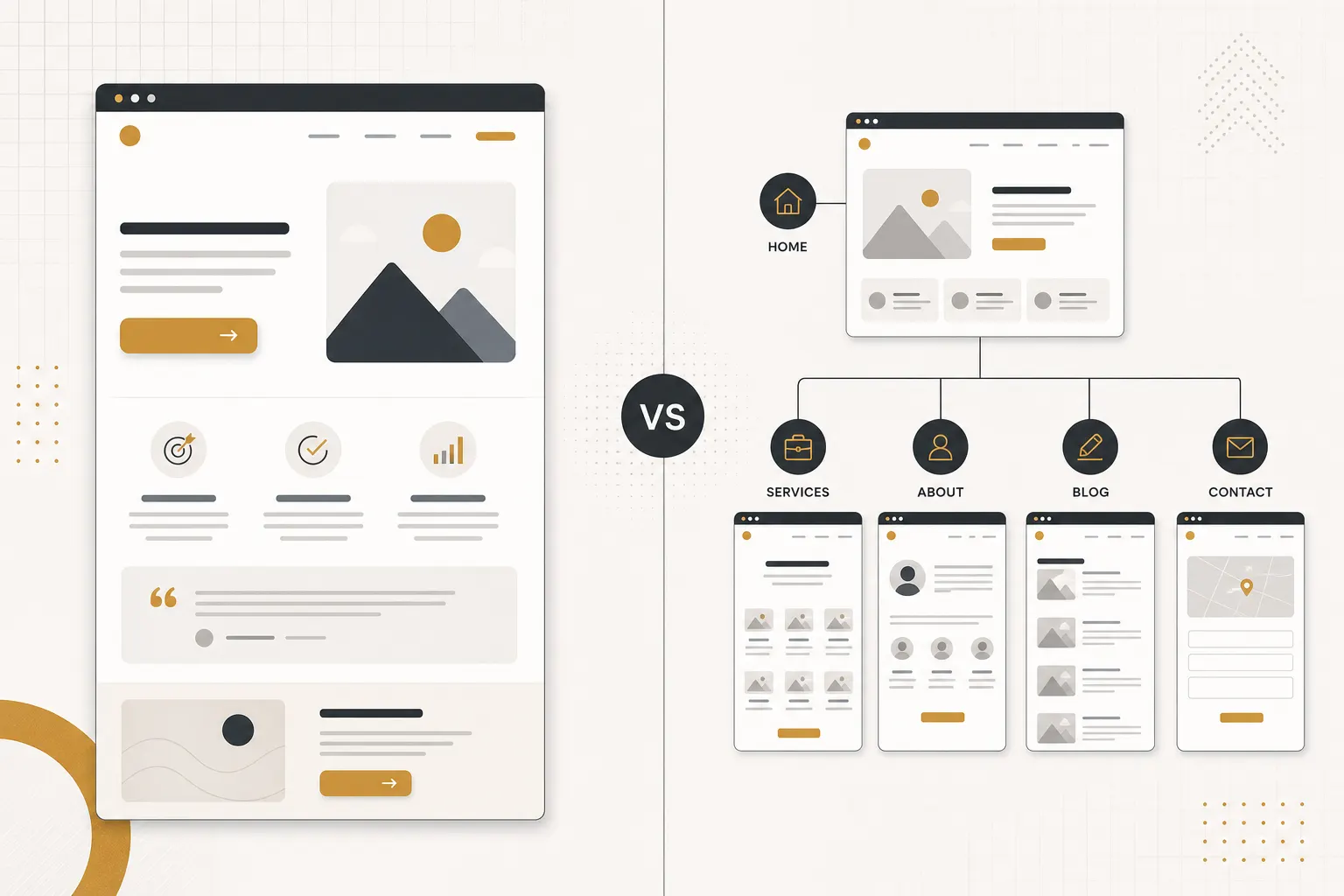
Advantages of a landing page
- Higher campaign focus: fewer exits, clearer CTA hierarchy, easier A/B tests.
- Better paid efficiency: message match improves Quality Score style signals and cost per lead.
- Faster learning: you validate an offer before funding a full custom website.
- Cleaner analytics: one primary event, easier landing page conversion reporting.
- Lower initial scope: less copy, fewer templates, shorter website development cycle.
When digital marketing spend is live, a lander is often the highest-leverage page you can ship. That is why I rarely send brand-new ad traffic to a busy homepage.
Advantages of a full website
- Compounding website SEO: multiple indexable URLs, internal links, topical coverage.
- Trust depth: proof, process, team, FAQs, and case studies in dedicated homes.
- Multi-service clarity: each offer can own a page instead of competing in one scroll.
- Always-on discovery: works when ads pause; supports long buying cycles.
- Brand hub: partners, press, and returning clients still need a durable destination.
A full site is infrastructure for business growth. It is slower to show ROI than a hot campaign lander, but it keeps working after the boost ends.
SEO comparison: landing page vs website
Website SEO favors depth and structure. Google needs clear topical pages, useful content, and internal pathways. A lonely campaign lander can rank for a narrow phrase, yet it rarely replaces a service-area site that targets many related queries.
Use a full website when organic search is a primary channel. Build service pages, location pages where honest, and supporting articles. Then connect them with intentional internal links. My SEO best practices for business websites checklist covers the technical baseline.
Use landing pages as supporting assets for high-intent offers, especially when paid search and SEO share keywords. Do not expect one page to carry every keyword your category needs.
If local SEO matters, a single lander is almost never enough. Maps, NAP consistency, and dedicated service pages do the heavy lifting. The lander can still catch ad clicks for “emergency same-day” style offers.
Conversion comparison
For matched campaign traffic, dedicated landers usually outperform general homepages. Benchmarks from landing page platforms often show median landing page conversion rates well above typical small business homepage rates for the same style of traffic. Treat benchmarks as directional, not destiny. Offer quality and traffic quality decide more than layout trends.
Homepages convert “okay” because they serve many intents. That is fine for brand searches. It is expensive when you pay per click.
What actually moves conversion rate
- Specific headline that restates the ad promise
- Proof near the form, not buried in a testimonials page
- Short forms and mobile-first user experience
- Fast LCP and stable layout (website optimization basics)
- One primary CTA, maybe one secondary contact path
For the page anatomy that converts, read lead generation website tips. This article stays on the choose-the-right-property decision.
Cost comparison and timeline
Website cost varies wildly by market and scope, so ranges matter more than viral price tweets.
| Build type | Typical scope | What you are paying for |
|---|---|---|
| Focused landing page | 1 page, form/booking, tracking | Offer clarity, design, speed, conversion setup |
| Small business website | 5 to 10 pages, SEO basics | IA, content structure, templates, integrations |
| Custom growth site | Design system, CMS, blog, CRM | Long-term flexibility and performance |
A lander is usually cheaper and faster. A full custom website costs more because content, navigation, and reusable components multiply. DIY builders can reduce cash cost and increase your time cost. Neither path is free.
Pro tip: Ask vendors to separate strategy, copy, design, development, and tracking. Bundle quotes hide why one “website” is three times another.
Maintenance comparison
Landing pages need campaign hygiene: retire expired offers, keep pixels healthy, and avoid broken thank-you flows. They are lighter day to day, but neglect shows up immediately in ad account ROAS.
Full websites need ongoing website optimization: content updates, dependency updates, new service pages, blog cadence, and broken-link checks. Maintenance is broader because the surface area is broader.
If nobody owns updates, choose the smaller surface first. An abandoned 12-page site can look less trustworthy than one sharp, current lander.
Real-world examples
Google Ads for a single service
A specialist contractor ran search ads to a homepage with six services and a blog teaser. Cost per lead was painful. We built one lander matching the exact ad group, removed the menu, and put reviews above the form. Same budget, clearer landing page conversion, sales stopped complaining about tire-kickers from unrelated services.
Local multi-service business
A clinic needed rankings for several treatments and city modifiers. A single page could not carry that SEO load. We shipped a compact multi-page site first, then added promo landers for seasonal campaigns. Organic and paid stopped fighting each other.
SaaS waitlist before product polish
A founder wanted a full marketing site plus docs. Users could not buy yet. We launched a waitlist lander with a demo video and email capture. After validation, we expanded into a proper marketing site. The lander prevented a premature website development bill.
Common mistakes businesses make
- Homepage as the ad destination: easy setup, expensive leakage.
- Building 15 pages for one offer: slow launch, diluted messaging.
- Calling a messy one-pager a lander: multiple CTAs are not focus.
- Ignoring mobile: most campaign traffic is phone-first; thumb targets matter.
- No tracking: if form submits are invisible in analytics, you cannot improve.
- SEO fantasy on a pure campaign page: paid landers rarely replace a content system.
- Never expanding: staying on only a lander forever caps brand and organic growth.
Common misconceptions
- “Landing pages are only for huge ad accounts.” Even small budgets deserve message match.
- “A full website always converts better.” Broader UX often converts paid traffic worse.
- “Templates cannot convert.” Weak offers fail on custom code too. Structure still matters.
Which option is best for different businesses?
| Your situation | Start with | Why |
|---|---|---|
| Paid ads starting this month | Landing page | Protect spend with focus |
| Multiple services + local SEO | Full website | Need indexable depth |
| Validating a new offer | Landing page | Fast feedback loop |
| Long B2B sales cycle | Full website (+ later landers) | Buyers research deeply |
| Event, webinar, or launch | Landing page | One date, one action |
| Growing brand with ads and SEO | Both (hybrid) | Hub + campaign spokes |
A simple decision checklist
- Do I have one offer and one primary CTA for the next 90 days?
- Is paid or email traffic the main source right now?
- Do customers need multiple pages of proof before contacting us?
- Do we need to rank for several services or cities?
- Can someone maintain more than one page weekly?
Mostly yes to the first two: lander first. Mostly yes to proof and SEO needs: full site first. Yes to both worlds: plan the hybrid deliberately.
Final verdict
There is no universal winner in landing page vs full website. A landing page is a conversion instrument. A full website is a growth system. Confusing the two is how budgets disappear.
If you need leads from a campaign this quarter, ship the lander. If you need durable discovery and brand trust, invest in the site. If you are serious about digital marketing at scale, budget for both, sequenced intelligently.
That hybrid is what I recommend to most clients once product-market fit or service-market fit is real: a fast, credible multi-page site, plus dedicated landers for each major offer.
Conclusion: actionable next steps
- Write your primary offer and CTA in one sentence.
- List your next 90 days of traffic sources.
- If ads or launches dominate, brief a landing page with tracking.
- If SEO and multi-service trust dominate, brief a compact full website.
- Schedule the missing half within a quarter so growth does not stall.
Want a second pair of eyes on the choice? I can review your offer, audience, and channels, then recommend landing page vs website scope without upselling pages you do not need. Start via the contact page, or explore custom website and landing page services when you are ready to build.
Available for hire — Abbottabad, Pakistan